


Before You Buy: A Pre-Purchase Installation Checklist for Kitchen Water Systems
A kitchen water system can be the right type of product and still be the wrong purchase if the site is not ready. Electrical work, water isolation, countertop finishing, and the order in which trades attend often become clear only after a unit has already been ordered.
If you are still deciding between a kitchen hot water dispenser and an electric tankless water heater, start with the use-case comparison in Instant Hot Water Dispenser vs. Tankless Water Heater: Which Does Your Kitchen Need?. The checklist below is for the next step: confirming installation conditions for a specific model before you order. The guidance is general. Compare your site with the manufacturer’s installation documents for the regional version of the model, and follow local codes. This article is not a substitute for those documents or for advice from a qualified installer.
1. Confirm the installation path before you compare finishes
Installation conditions depend on how the system will be fitted, not on how it appears in a product photograph.
Record whether the project is a new build, a renovation in which services can still be moved, or a retrofit into a finished kitchen. Existing pipework, electrical points, and countertop openings are constraints in a finished space. In a renovation, they can often be planned, but only if they are specified before the kitchen is closed up.
Then record the installation path: a countertop appliance, an under-sink system, a wall-mounted heater, or another arrangement described by the manufacturer. Each path has different requirements for connections, access, and finishing. A compact appearance does not, by itself, establish that a model will suit the site. Suitability comes from matching the site to that model’s documents.
If a fixed water line is not available at the intended location, do not assume a connected system can be installed there. Some drinking-water appliances support another supply arrangement; confirm that path with the supplier before ordering. WINTEMP’s article No Fixed Water Line? Axis Countertop Pro Keeps Refreshment Simple discusses flexible supply in a countertop context.
2. Ask for the installation pack and compare it with the site
Before purchasing, request the installation documents for the exact regional model. A useful pack typically includes:
- Overall dimensions and clearances for ventilation, connections, and later service
- Plumbing connection information, including any drain or overflow arrangement
- Electrical data for that regional specification
- Compatible faucet information, including opening size and deck-thickness limits where a dedicated faucet is used
- Any site conditions the manufacturer states as required or recommended, such as incoming water pressure or pretreatment
Compare those documents with the actual location. Photographs of the proposed position, the nearest water isolation point, and the electrical supply will help a supplier or installer comment before you commit. Take measurements from the space as it will be at installation. Do not rely on a previous project, a showroom display, or a similarly described product.
3. Check electrical conditions against the regional model
Confirm electrical suitability early, because changes to wiring or protection devices can affect cost and schedule. The regional model must match the supply voltage and frequency at the site. A unit intended for another market is not interchangeable simply because the product family looks the same.
Ask the installer to compare the site supply with the electrical requirements in the model’s documents and with local electrical regulations. That review should cover the type of connection (a receptacle or a fixed wiring arrangement), the circuit that would serve the appliance, and a practical means of isolation for installation and service. Do not assume that a spare receptacle near the kitchen is sufficient. If the existing supply may need alteration, involve a qualified electrician before you order.
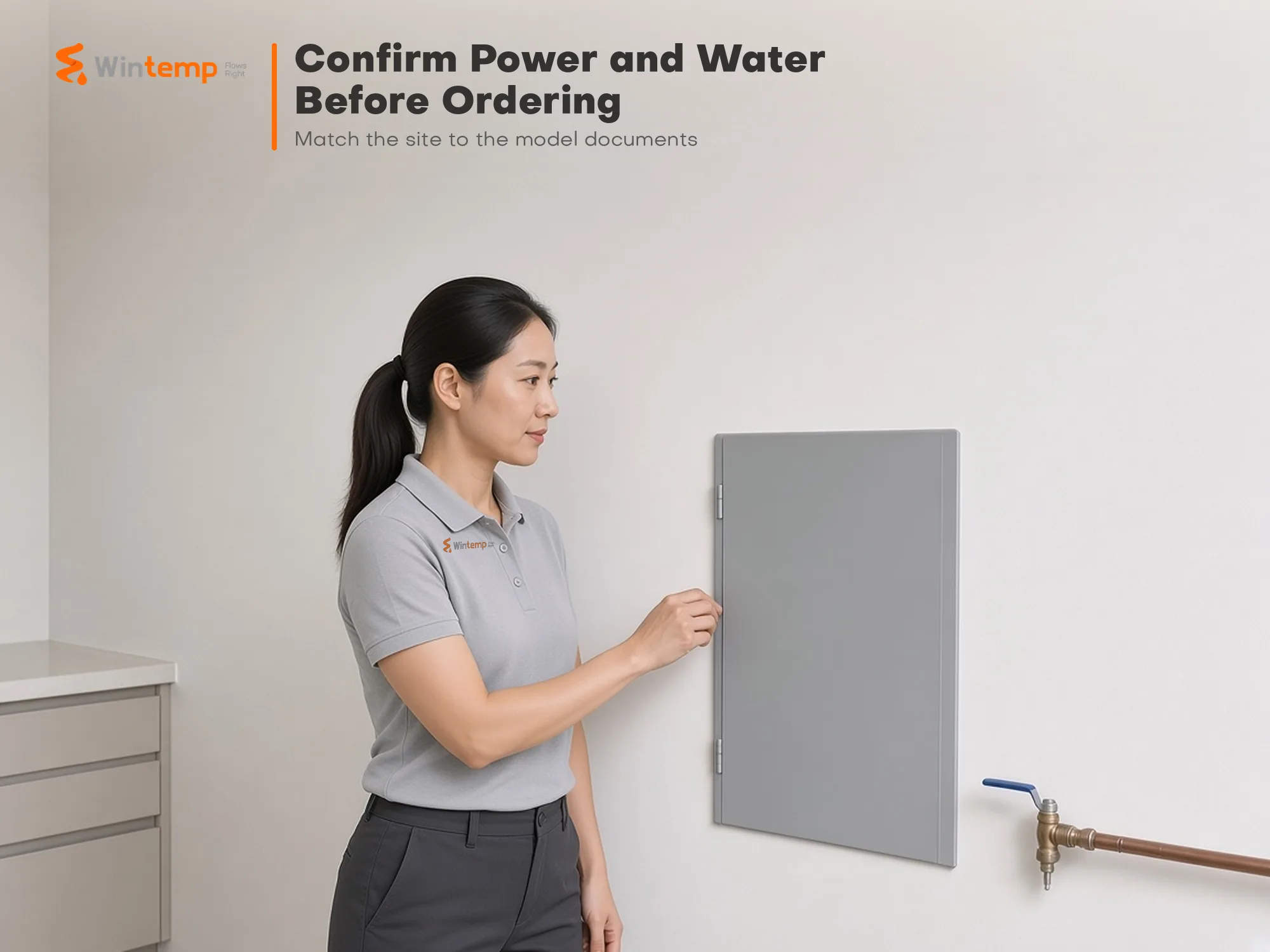
4. Confirm water supply, isolation, and water condition
A clear, accessible isolating valve is essential. The installer should be able to shut off water to the appliance during fitting and later service without turning off a larger part of the property unnecessarily. If no suitable isolation exists, plan that work as part of the project.
Check that the pipework and connection type can be adapted to the fittings specified for the model. Where the documents state an operating range for incoming water pressure or temperature, compare those figures with known site conditions. If the data are not available, say so in your enquiry rather than assuming typical values.
Also ask the supplier whether pretreatment or filtration is required or recommended for your water conditions and the selected model. Hardness, sediment, and other local conditions can affect specification and maintenance. Do not assume that a drinking-water or heating appliance includes the same filtration, or that a filter used on another appliance is automatically compatible. If the system requires a fixed water connection and the location cannot provide one, stop and revisit the installation path.
5. Plan countertop, faucet, and finishing work in the right order
Many installation problems appear at the countertop, not at the appliance body. If a dedicated faucet or dispenser outlet is required, establish whether an existing opening can be used or a new opening must be cut. Note the countertop material and thickness, and agree who is responsible for any cutting, especially in stone or composite surfaces. The opening size and deck thickness must fall within the range specified for the chosen faucet, and the position must be workable relative to the sink or basin.
Coordinate this work with the kitchen fabricator, plumber, and electrician. In a renovation, agree services and openings before the countertop is fitted. In a retrofit, confirm that cutting or drilling is possible in the finished surface.
For a wall-mounted heater, the equivalent checks apply to the mounting surface, fixing height, and the clearances stated in the documents. Confirm that the wall or support can accept the method specified by the manufacturer, and that connections remain accessible after the unit is mounted.

6. Leave a route for service, drainage, and a rapid shut-off
Fitting the unit is only part of a workable installation. After nearby doors, panels, or other equipment are in place, connections, any user-serviceable parts identified in the manual, and the electrical and water isolation points should still be reachable.
If the documents require a drain, overflow, or drip arrangement, plan that route now. Agree where the water is isolated and who is responsible for first-line checks after installation. These points are easier to solve on paper than after the kitchen has been completed.
7. Assign the trades, permissions, and installation sequence
Identify who will do the work. Many kitchen water systems require both plumbing and electrical trades; some locations also require licensed or registered installers. Check local regulations, and any building-management or homeowners’ association rules, before you purchase. Ask the supplier whether support or warranty conditions depend on installation in accordance with the manual, or on installation by a qualified person, and follow the written terms for the model and region.
Then set the sequence. In a new kitchen, rough-in of water and power should be complete before the countertop and finishes close the space. In a retrofit, agree access, protection of existing surfaces, and a commissioning plan. Also confirm the delivery path so the unit can reach the installation location without damage.
A brief you can send with your enquiry
Before asking a supplier to confirm a model, prepare a short installation brief:
- Country or region of installation, and whether the project is a new build, a renovation, or a retrofit
- The intended installation path (countertop, under-sink, wall-mounted, or another documented arrangement)
- The intended use and the outlet to be served
- Photographs of the proposed location, the water isolation point, and the electrical supply
- Available electrical information, including supply voltage and what is already present at the location
- Water supply details, including connection type, isolation, and any known pressure or water-quality information
- Countertop material and thickness, and whether an existing opening will be used
- Any constraints on access, working hours, or building rules, and the trades who will install the system, if already appointed
Take this brief to the WINTEMP product range and contact WINTEMP to discuss options for your market. A complete site picture is more useful than a product name on its own.
Meet WINTEMP at SAUDI HORECA 2026:
Exhibition: SAUDI HORECA 2026
Dates: December 7–9, 2026
Venue: Riyadh Front Exhibition & Conference Center, Riyadh, Saudi Arabia
Location: Hall No. 2, Booth F251
Read Meet WINTEMP at SAUDI HORECA 2026: Water Solutions for Hospitality. To arrange a conversation in advance, please use the Contacte-Nos page.
 English (United States)
 English (Australia)
 German
 French
 Russian
 Italian
 English (UK)
 Turkish
 Spanish
 Portuguese
 Vietnamese
 Tagalog
 Kazakh
 Kyrgyz
 Belarusian
 Chinese